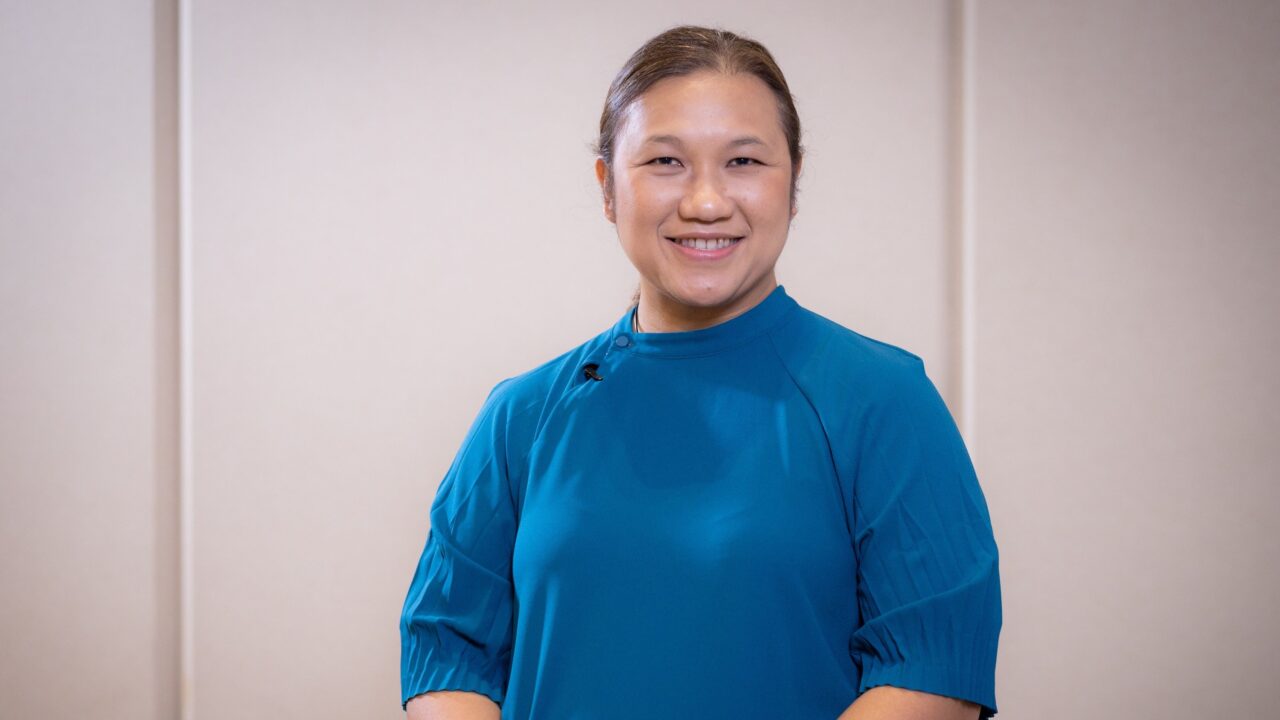
This is a verbatim transcript of an interview conducted with Ms Donna Miranda in October 2025. The transcript has been lightly edited for clarity.
Introduction
Hi, I’m Donna Miranda. I’m Project Officer of Women’s Cancers portfolio of Jhpiego Philippines. I look after our cervical cancer elimination program.
What drives me to be an actor in this field, in this space, is seeing how women can avail of services that are not oftentimes easy to access. So that, that really drives me, whether this is a cervical cancer elimination project or this is a maternal child health program. It’s just being on the ground and seeing that access is possible where it was once not possible.
From current barriers to future breakthroughs, what will it take to achieve the global elimination of cervical cancer?
Cervical cancer is really an illness of inequity. In low-middle-income countries, it is the poorest and most vulnerable sectors of the population that are adversely affected. Our studies also show, and our data also show, that it is unscreened women who are unable to access, who mostly become vulnerable to developing cervical cancer. And yet, they are also the ones who are not motivated to seek health care.
The single most significant barrier in achieving these goals is the weak health system, the weak access to services. Primary health centers are not accessible. There is a shortage in the health workforce in our primary services. And then, lastly also, there’s poor access to commodities and diagnostic platforms.
In the Philippines, 12 women die of cervical cancer everyday (IARC, 2025). Every year, 15 women out of 100,000 will be diagnosed with cervical cancer. Half of them will die in the same year of their diagnosis. And this high prevalence and high morbidity of cervical cancer, of course, is attributed to three things: low vaccination coverage, low screening rates, and delayed access to treatment.
Partnership: What is CLAMS? What was the need for such a partnership and what was the scope of partnership between Jhpiego and Roche for the project?
CLAMS is “Centralised Laboratory for HPV DNA Screening in the Philippines”. So this was conceived in order to come up or as a response to the growing need to demonstrate a scalable central laboratory model for HPV testing. To support the country in its direction towards transitioning to HPV testing.
This was designed and implemented by Jhpiego with the support of Roche Diagnostics, and technical guidance of the Department of Health, Cancer Control Division, and our local health partners through the local health offices. So, CLAMS aims to contribute in achieving the national goal for eliminating cervical cancer as a public health burden.
What CLAMS did was provide a model to help the government understand how they can use a central laboratory platform and a high-throughput testing platform to meet their elimination goals, and what service delivery models would be needed in order to use a central laboratory. ‘Cause and I like saying this, you know, specimens, they don’t walk to laboratories, right? You need a referral model to get the specimens collected from the women, and so that they go to the laboratory, and then to get the results back to the women.
Outcomes: What are some key outcomes from the CLAMS project? How will these help move from pilot to program implementation in the Philippines?
We were able to screen 4,925 women, and demonstrated the viability of HPV DNA testing as a primary screening modality for cervical cancer. Because of the 4,925 women screened, we detected a 9 to 10% positivity rate, and also demonstrated the viability of self-sample collection with invalid rates of less than 1%.
Of the 4,925 women who screened using HPV DNA testing, 99% collected through self-sample collection. So there is no question that self-sampling is acceptable to women. They were also acceptable to the provider themselves, as we did a bit of an interview and they were providing feedback, they were very happy with this self-sample collection because they can reach more women.
Challenges and Learnings: What are the top challenges and learnings from the project which other countries should consider in their program implementation?
Screening will not prevent cervical cancer. What we need to do is find women who are positive for high-risk HPV and link them to treatment. And here is where we had very, very good learnings, because in the beginning, we thought the solution was just the centralized screening, centralized testing, and then lead women to available treatment centers.
But that meant that the women would still have to go through lengths to get treatment. And so what we did midway through the project was decentralized treatment at the village level, at the primary health level. And by doing so, we were able to improve return for treatment rates from around 30% when we were beginning to 54%.
So what did we learn in CLAMS? We learned that decentralized screening works, centralized testing works, but we need to decentralize treatment. We need to train our providers not just in screening, but train them in the programmatic prevention of cervical cancer, and here is where we demonstrated the screening-linked-to-treatment approach using a centralized platform. In order to operationalize, we gave shape to this using a hub-and-spoke model.
So the hub-and-spoke model actually originates from the transport sector where you have a central hub and you have different pathways to the hub through the spokes. And so we used the same concept in delivering services. We established project hubs where treatment was provided to the patients, where supply chain and inventory was managed, where clinical management of all patients was also monitored and administered. But we established spokes connected to these project hubs. The main responsibility of the spokes was to do the screening.
The spokes will be collecting samples, will be doing screening activities, whether in the facility, in the neighborhood, in the community center, in workplaces, in markets, everywhere. They will do the screening, and then they will pool their samples, pull the specimen, send it to the project hub, and then the project hub will send it to the central laboratory.
Creating a Legacy: The Philippines aims for cervical cancer elimination by 2030, aligned with the WHO’s 90-70-90 targets. What will be the most critical, enduring legacy of the CLAMS project that helped turn this national commitment into a scalable reality?
Almost 70% of health care in the Philippines is provided by the private sector. While it is the mandate of the national government to provide services to its population through the public health system, the system currently just cannot. We need to be able to create an ecosystem where private and public health providers and health facilities can work together to meet favorable outcomes.
In the Philippines, this is possible through the Universal Health Coverage law, where the law provides guidance for local health systems to build what they call Health Care Provider Network. And this Health Care Provider Network need not be public providers. They are a mix of private and public health providers. Interestingly, it is also a mix of non-medical and medical health providers.
We created that ecosystem for a private-public partnership in order to create a service delivery pathway for secondary prevention of cervical cancer. In a country like the Philippines where the delivery of public health services are very fragmented, I cannot overemphasize the need for private and public sector support.
Luckily, in our country, policy mechanisms and health financing mechanisms make this possible. We have already demonstrated the proof of concept of a screening-linked-to-treatment approach using HPV DNA testing, high acceptability for self-sample collection. We also supported the country to receive a health technology assessment for positive recommendation of HPV DNA testing in the Philippines.
Awareness is a critical component of public health. What is one message you hope a wider, non-scientific audience takes away from a conference like this?
The final message is that, at the end of the day, health is a right, and we should be able to understand that we all have a stake in us exercising those rights. We need to create an enabling environment so that everybody can avail of their rights.
Most of our health problems, they’re driven not by clinical problems. They’re driven by social economic problems. And at the end of the day, in order for women, all of us to avail of our health, we all need to support each other, empower each other so that all of us can avail of our right to health and participate in keeping our families, ourselves, our communities healthy.
The views and opinions expressed by Ms Donna Miranda are her own views and opinions. Roche disclaims all liability in relation to these views and opinions.
References:
- IARC (2025). IARC Biennial Report 2024–2025. Lyon, France: International Agency for Research on Cancer. Available from: https://publications.iarc.who.int/657. Licence: CC BY-NC-ND 3.0 IGO.
- Philippine Commission on Women, May 21, 2025. Available at https://pcw.gov.ph/towards-a-cervical-cancer-free-future-for-all-filipinas/. Accessed Jan 2026.
- UNFPA Asia-Pacific Regional Office. (2022, January 28). Philippines: Cervical cancer elimination – Country review & roadmap for action. UNFPA Asia-Pacific Regional Office.
- Domingo et al. J Gynecol Oncol. 2009 Mar;20(1):11-16.